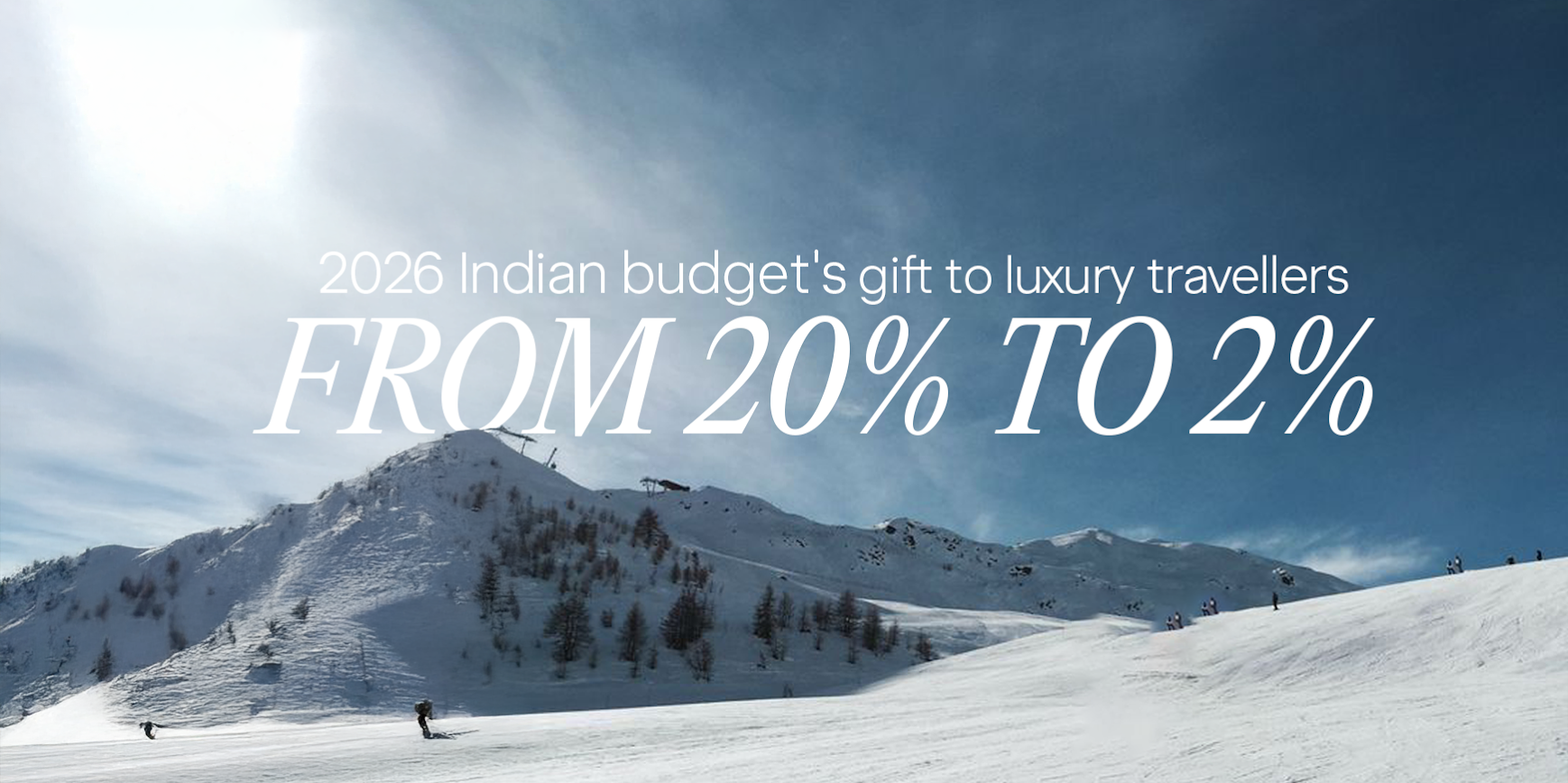
The reduction of TCS to 2% in the Indian Budget 2026 offers significant advantages for luxury travellers. Panache World’s founders, Sanjar and Loveleen, explain how this enhances financial flexibility, broadens destination options, and strengthens the value proposition.

The Union Budget 2026 has generated considerable discussion regarding reforms to TCS and TDS. For discerning luxury travellers, however, the focus lies in the tangible benefits to international travel planning. Panache World’s founders, Sanjar and Loveleen, have analysed these changes and explain how for a traveller it expands and restores control over travel expenditures.
Enhanced financial flexibility for trip budgets
Consider planning a bespoke trip that costs ₹20 lacs. Under the existing tax laws, travellers are required to budget upwards of ₹25 lacs upfront, comprising 5% GST on the package value and a steep 20% TCS on overseas tour spending (exceeding ₹10 lacs annually). Sanjar described this as a liquidity constraint, with approximately ₹4 lacs of TCS effectively collected towards income tax.
Effective 1 April 2026, TCS is reduced from 20% to a uniform 2% for all overseas tour packages. The same ₹20 lakh journey will now require only ₹40,000 (instead of ₹4 lacs) to be collected upfront. This adjustment, as Sanjar notes, eliminates the necessity for overbudgeting, thereby expanding the scope of affordable travel arrangements.
Expanded destination viability
In recent years, travellers have adjusted their aspirations to accommodate the steep 20% tax collected at source, frequently selecting less expensive destinations such as Bali in lieu of an European journey. The diminished TCS burden restores viability to these premium long-haul pursuits. This is no silver bullet, but we project sustained demand growth within 3-6 months. Industry analyses corroborate this outlook, anticipating increased investment in experiential elements among HNI, which is encouraging for companies like Panache World, which go beyond ticketing and booking just accommodation.

But wait. What is TCS?
TCS (‘Tax Collected at Source’) operates as an advance collection of income tax at the point of transaction, quite similar to TDS (‘Tax Deducted at Source’) on salaries. Loveleen illustrates: “For a ₹10 lakh booking, where the government previously claimed 20%, increasing the immediate outlay to ₹12 lakhs plus GST, with funds potentially unavailable for up to a year pending reconciliation. This mechanism previously influenced payment decisions and relationships with planners”. The new 2% rate aligns TCS with that applied to luxury vehicles or property, establishing a more equitable framework.
Why this brings Indian travel designers to the fore
The previous high TCS rates adversely affected Indian travel designers, prompting clients to make direct payments to overseas hotels or operators, thereby avoiding the levy. This resulted in substantial turnover losses for Indian travel designers, including instances where we ourselves recommended our clients to pay for hotels directly. Loveleen underscored the rationale: “It is unfeasible to expect a client to keep their funds immobilized for 6-12 months, depending on when they travelled”. At 2%, Indian travel companies regain competitiveness, offering expertise in tailored experiences without disproportionate tax implications. The Budget’s intent explicitly supports repatriating business to authorised Indian operators.
For a ₹40 lacs family European itinerary, the prior structure immobilised ₹8 lacs in TCS; the revised rate limits this to ₹80,000, liberating ₹7.2 lacs for enhancements including better accommodation, private guides, and exclusive dining. Annual multi-destination travel becomes more practicable, unencumbered by progressive tax accumulation.
TCS on foreign credit card spends gets added automatically, but credit card companies often mess it up or forget to link it to your taxes. And when you want to reach them to fix this, it can become a challenge. With Panache World as your travel designer, we track it for you, keep you updated, and fix any issues fast—so it all works smoothly with your income tax return.

How we expect luxury travel behaviour to evolve
From an insider’s lens, we anticipate a gradual but meaningful shift over the next few months, rather than an overnight spike. Global economic uncertainty, currency movements, and geopolitical factors still influence outbound travel decisions, especially at the very top end.
However, two behavioural trends are likely among Indian luxury travellers:
- Return of curated itineraries: Travellers who had temporarily moved to direct-pay or piecemeal bookings are likely to come back to full-service planners now that the “tax penalty” has largely gone.
- Bigger, bolder trips: Where budgets were previously cut to avoid heavy TCS, you are more likely to see families choosing longer stays, more varied routing (multi-country Europe, world cruises), and rare experiences they had postponed.
For discerning travellers, this Budget effectively reopens the world with fewer artificial brakes. The destination you truly want—and the way you want to experience it—is now easier to reach without feeling that a disproportionate chunk of your budget is disappearing into limbo as advance tax.
At Panache World, we’re already recalibrating itineraries to maximise these tax efficiencies—whether that’s structuring the optimal blend of packaged experiences and standalone bookings, or unlocking those bolder European odysseys and rarefied retreats you’ve deferred.
Ready to experience travel without artificial constraints? Contact your Panache World consultant today or email info@panacheworld.com to book a 30-minute no-obligation consultation. The world awaits!